

Takis Talk Episode 16 – Small Power Plant Exemption – Data Center Moratorium – Massive Water Consumption
Professional Platform
Share this episode of Takis Talk
AB 1738 Remote Inspections: California's New Law and What Building Departments Should Do Now
On September 18, 2026, Governor Newsom signed Assembly Bill 1738, and California became the first state to guarantee homeowners and contractors the right to request a remote inspection for certain residential projects. The bill adds Section 17970.9 to the Health and Safety Code, and it puts every covered city and county on a clock. In this solo episode of Takis Talk, host Greg Diktakis walks through what AB 1738 actually says, what got cut on the way to the Governor's desk, and how a building department can build a remote inspection program that holds up.
The Bill That Almost Was
Greg opens with the part that still has him shaking his head. The April committee analysis for AB 1738 listed a long roster of registered supporters, including environmental groups, climate organizations, physicians' associations, and asthma-prevention advocates. The lone registered opponent was the California Building Officials, the one organization made up of people who actually perform inspections for a living. The subject-matter experts said no, and the bill moved anyway.
The silver lining is that the version signed into law is far narrower than the original. Early drafts covered water heaters of every type, all HVAC, foundations and rebar, framing, ADUs, home hardening, defensible space, electrical panels, and all PV and energy storage work. The chaptered bill trims that list to five categories in single- and two-family dwellings.
The Five Covered Categories
Greg breaks down each one and where the lines are drawn:
1. Heat pump water heaters, including the electrical alterations needed to support them. If the load calcs do not pencil and the job triggers a new main service panel, the jurisdiction is not required to inspect that new service remotely.
2. Heat pump HVAC systems, with the same logic. The system and its appurtenant work are in; the ripple-effect upgrades are not automatically included.
3. Residential re-roofs. Greg has been lobbying his own CBO to pilot this one for a while, drones and all.
4. PV systems rated 15 kW AC or less, plus energy storage systems.
5. Smoke detectors and carbon monoxide detectors.
As a former HVAC contractor, Greg explains why he is comfortable with this list. An 80 percent furnace in an attic with a B-vent has a dozen ways to go wrong, from arrow direction to clearances to slope. An air handler for a heat pump is refrigerant lines, condensate, and power. The risk profile is different, and the remote method fits.
How the Process Works
The statute requires the local agency to offer the option. The homeowner provides written consent, and the contractor makes the request. Alternatively, the jurisdiction can require remote inspection for covered work, in which case the contractor must disclose that to the homeowner. Inspections can be live videoconference or submitted photos and recorded video, at the inspector's discretion.
Two provisions Greg calls out as wins for departments: if the inspector cannot verify compliance remotely, the inspection fails and converts to an in-person visit, and jurisdictions may temporarily ban a homeowner or contractor who willfully misrepresents work, up to six months for a first offense and twelve months after that. Local agencies can even agree to honor each other's bans.
Eligibility Is the Doorway, Not the Destination
The sentence Greg wants every department to put at the center of its procedures: eligibility for remote inspection does not guarantee remote approval. The law changes the method of observation, not the standard of compliance. Inspectors still apply the adopted code, the approved plans, the manufacturer's instructions, the listings, and professional judgment. ”Show me the left side again” and ”I need to see this in person” are both signs of a program working as intended.
Field Lessons From COVID-Era Video Inspections
Greg shares the stories that make the case for structure. The contractor who admitted, ”I show them what I want to show them.” The job where the Wi-Fi mysteriously died in the back corner. The PV correction photo that came back showing a Ufer in a communications box on a house with white stucco, when the house he had inspected an hour and a half earlier was salmon. Start every remote inspection at the street, confirm the address, go wide before you go tight, and sweep the area again before you sign off.
Building the Program
The second half of the episode is a practical checklist for building officials and inspection supervisors:
· Flag covered permits in your permitting system and decide how you will handle mixed-scope jobs.
· Tell applicants exactly what to have ready: ladder, flashlight, approved plans, stable connection.
· Give inspectors the hardware to do it well. A large split-screen monitor with plans on one side and the live feed on the other changes the game.
· Write a protocol for when to jump off a remote inspection, and disclose it so nobody gets an eleventh-hour surprise.
· Decide with your city attorney whether you will record and retain video, and where it will live.
· Confirm your portal updates in real time so the applicant sees the result the moment you hit enter.
· Pilot it. Put one of your own inspectors on the contractor side and have them try to break it.
· Train everyone, because the tech-savvy and the tech-reluctant both have to deliver the same inspection.
The Deadlines
Most covered jurisdictions must comply by January 1, 2028. Qualifying cities of 50,000 or fewer residents have until July 1, 2028. Cities under 5,000 and counties under 150,000 are exempt. Greg's advice: that date is closer than it looks, and budgets, hardware, and software integration take time. He also predicts this is only the first installment, with the covered list growing in future sessions.
Convenience is not evidence. The inspection counter may be moving to the phone, but the responsibility is not. Listen in, then share the episode with your building official, inspection supervisor, and permit manager.
Find more episodes and resources at takistalk.com, and reach out to Greg on LinkedIn with your own remote inspection stories, wrong-color-stucco photos included.

Data Center Permits: What Building Departments Must Ask
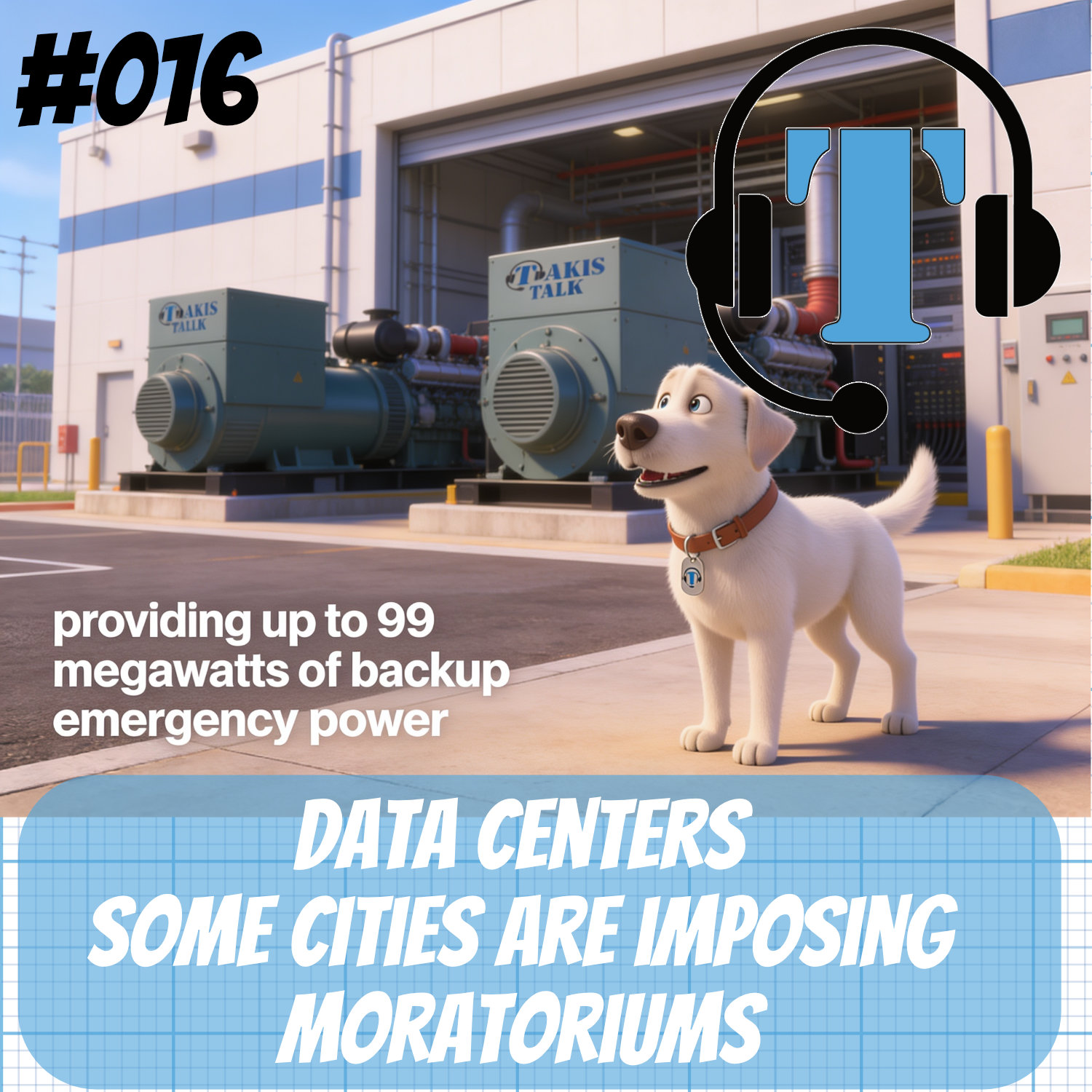
Forty diesel generators. Ninety-nine megawatts. Forty thousand gallons of water. Those numbers don’t describe a science-fiction plot — they describe a data center proposal that could land on your permit counter next month.
Understanding the data center permit review process will help mitigate risks associated with large-scale projects.
And when it does, the building will probably look like an office building.
Identifying potential challenges in the data center permit review can lead to more effective planning and execution.
That’s the quiet risk in data center permit review. A familiar-looking structure makes an unfamiliar project feel routine. Tilt-up walls, a modest entry, a big flat roof. Nothing about the elevation warns you that inside is a facility with the electrical demand of a small city, the cooling needs of an industrial plant, and a backup power system that changes how your fire and air-quality reviews have to work.
Awareness of the complexities involved in a data center permit review will help in achieving compliance and regulatory standards.
Our understanding of the data center permit review process must align with local regulations to avoid compliance issues.
The data center permit review process is essential for ensuring that all local regulations are met before project approval.
“Looks Like an Office Building” Is How Reviews Go Wrong
Each stage of the data center permit review should be approached with diligence to avoid oversights.
Before “looks familiar” becomes “approved,” a review team needs answers to a few operational questions that don’t appear on a typical plan set:
-
- How will the facility actually operate? Load profile, redundancy tier, expansion phases, and whether the shell you’re approving today is sized for a much bigger build tomorrow.
- What will it demand from local infrastructure? Feeder capacity, substation timing, water supply, sewer discharge, and road impacts during and after construction.
- How is it cooled? Air-cooled, evaporative, or liquid cooling each carry different water volumes, mechanical equipment, and long-term utility consequences.
Analyses during the data center permit review are fundamental for understanding infrastructure impacts and future needs.
- What happens when the power fails? Generator count, fuel storage quantities, permitting for emissions, testing schedules, and the noise those tests generate.
None of these are exotic questions. They’re just questions that rarely get asked when a project reads as “commercial shell.”
99 Megawatts Is Not a Coincidence
Here’s where code professionals should sharpen their instincts. In California, data centers with capacities between roughly 50 and 100 megawatts can pursue a Small Power Plant Exemption (SPPE) instead of going through the California Energy Commission’s full Application for Certification (AFC) process. Above 100 megawatts, that exemption lane closes.
Engagement during the data center permit review fosters better understanding and smoother processes among stakeholders.
So when a proposal arrives at 99 megawatts, that number isn’t a coincidence. It’s a design decision.
That’s the broader lesson worth carrying into every review: regulatory thresholds don’t just shape how projects get reviewed — they shape how projects get designed. Once you understand that, you start reading applications differently. You notice numbers that sit suspiciously close to a line. You ask what happens in phase two. You ask whether a future expansion quietly re-triggers a process everyone just avoided.
Every aspect of the design must consider the upcoming data center permit review to ensure all facets are addressed.
Each design phase must contemplate the upcoming data center permit review to ensure compliance and operational readiness.
Being the Local Layer Without Being the Weak Link
The most dangerous sentence in a multi-agency review is: “I thought another agency was handling that.”
That’s not a review strategy. When a data center proposal comes through, the question isn’t simply “who’s approving this?” It’s:
Clearly defined objectives in the data center permit review process can improve project outcomes and community relations.
-
- What exactly is each agency reviewing?
- What remains the local team’s responsibility?
A proactive approach to the data center permit review can lead to enhanced stakeholder collaboration and satisfaction.
- Who is verifying that nothing falls between those reviews?
State energy review, air district permits, water agency approvals, and utility interconnection all cover pieces of the picture. None of them covers your local code compliance, your inspection program, or your community’s expectations. Being the local layer should never mean being the weak link.
A Moratorium Buys Time, Not Answers
It’s essential to recognize how data center permit review influences project timelines and stakeholder relations.
Maximizing the potential of the data center permit review will yield substantial benefits for project timelines and community impact.
Many jurisdictions respond to data center pressure with a moratorium. Asking for more time can be entirely reasonable — but the follow-up question matters more than the pause itself: more time to do what?
Used well, that window produces real deliverables: an infrastructure demand study, clearer submittal and review standards, defined thresholds for when projects get elevated, and a shared information base so building, planning, fire, public works, utilities, and city leadership aren’t working from different assumptions. Used poorly, the clock simply runs out and the same unprepared team faces the same application.
Efficient data center permit review practices lead to smoother project execution and community satisfaction.
If your city is considering data centers, the work performed during a moratorium deserves as much attention as the decision to adopt one. What needs to be studied? Who owns each piece? What does “ready” look like?
Engaging the community early can improve the data center permit review process significantly.
Start the Conversation Before the Application
The best time to build your data center review approach is before a proposal exists. Get the departments in one room. Walk through a hypothetical submittal. Identify the gaps while the stakes are still theoretical.
Building a strong foundation for data center permit review will streamline future applications and approvals.
Because the real question for your community isn’t only “can we bring this project here?”
Ultimately, the data center permit review must comprehensively address community concerns to ensure a successful project integration.
It’s “what do we need to understand before we do?”
Listen to the data center episode of Takis Talk at TakisTalk.com, on Apple Podcasts, or on Spotify.