

A simple podcast concept
Curate some of the best & brightest guests in the public sector.
Showcase my guests’ accomplishments, share their experiences, insights and advice.
Provide my audience with information to help manage their teams and further their careers.
Publish on the most popular platforms Spotify & Apple Podcasts.
Listen Anywhere
At Work


While walking the dogs
On a road trip
(You know the fam wants to hear about the latest ADU legislature)

Takis Talk – The Latest Episode
Have a listen.
Professional Platform
Share this episode of Takis Talk
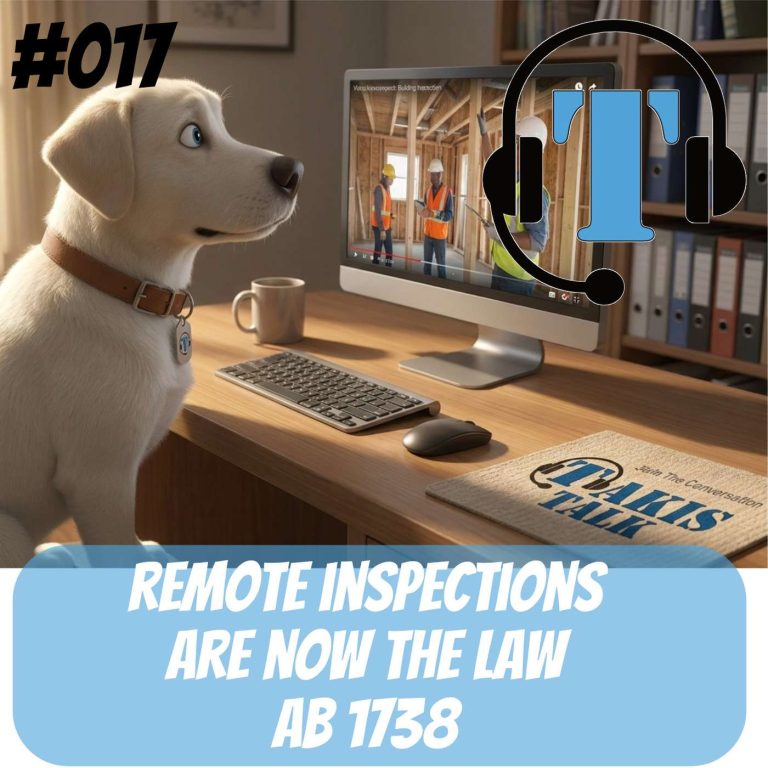
AB 1738 Remote Inspections: California's New Law and What Building Departments Should Do Now
On September 18, 2026, Governor Newsom signed Assembly Bill 1738, and California became the first state to guarantee homeowners and contractors the right to request a remote inspection for certain residential projects. The bill adds Section 17970.9 to the Health and Safety Code, and it puts every covered city and county on a clock. In this solo episode of Takis Talk, host Greg Diktakis walks through what AB 1738 actually says, what got cut on the way to the Governor's desk, and how a building department can build a remote inspection program that holds up.
The Bill That Almost Was
Greg opens with the part that still has him shaking his head. The April committee analysis for AB 1738 listed a long roster of registered supporters, including environmental groups, climate organizations, physicians' associations, and asthma-prevention advocates. The lone registered opponent was the California Building Officials, the one organization made up of people who actually perform inspections for a living. The subject-matter experts said no, and the bill moved anyway.
The silver lining is that the version signed into law is far narrower than the original. Early drafts covered water heaters of every type, all HVAC, foundations and rebar, framing, ADUs, home hardening, defensible space, electrical panels, and all PV and energy storage work. The chaptered bill trims that list to five categories in single- and two-family dwellings.
The Five Covered Categories
Greg breaks down each one and where the lines are drawn:
1. Heat pump water heaters, including the electrical alterations needed to support them. If the load calcs do not pencil and the job triggers a new main service panel, the jurisdiction is not required to inspect that new service remotely.
2. Heat pump HVAC systems, with the same logic. The system and its appurtenant work are in; the ripple-effect upgrades are not automatically included.
3. Residential re-roofs. Greg has been lobbying his own CBO to pilot this one for a while, drones and all.
4. PV systems rated 15 kW AC or less, plus energy storage systems.
5. Smoke detectors and carbon monoxide detectors.
As a former HVAC contractor, Greg explains why he is comfortable with this list. An 80 percent furnace in an attic with a B-vent has a dozen ways to go wrong, from arrow direction to clearances to slope. An air handler for a heat pump is refrigerant lines, condensate, and power. The risk profile is different, and the remote method fits.
How the Process Works
The statute requires the local agency to offer the option. The homeowner provides written consent, and the contractor makes the request. Alternatively, the jurisdiction can require remote inspection for covered work, in which case the contractor must disclose that to the homeowner. Inspections can be live videoconference or submitted photos and recorded video, at the inspector's discretion.
Two provisions Greg calls out as wins for departments: if the inspector cannot verify compliance remotely, the inspection fails and converts to an in-person visit, and jurisdictions may temporarily ban a homeowner or contractor who willfully misrepresents work, up to six months for a first offense and twelve months after that. Local agencies can even agree to honor each other's bans.
Eligibility Is the Doorway, Not the Destination
The sentence Greg wants every department to put at the center of its procedures: eligibility for remote inspection does not guarantee remote approval. The law changes the method of observation, not the standard of compliance. Inspectors still apply the adopted code, the approved plans, the manufacturer's instructions, the listings, and professional judgment. ”Show me the left side again” and ”I need to see this in person” are both signs of a program working as intended.
Field Lessons From COVID-Era Video Inspections
Greg shares the stories that make the case for structure. The contractor who admitted, ”I show them what I want to show them.” The job where the Wi-Fi mysteriously died in the back corner. The PV correction photo that came back showing a Ufer in a communications box on a house with white stucco, when the house he had inspected an hour and a half earlier was salmon. Start every remote inspection at the street, confirm the address, go wide before you go tight, and sweep the area again before you sign off.
Building the Program
The second half of the episode is a practical checklist for building officials and inspection supervisors:
· Flag covered permits in your permitting system and decide how you will handle mixed-scope jobs.
· Tell applicants exactly what to have ready: ladder, flashlight, approved plans, stable connection.
· Give inspectors the hardware to do it well. A large split-screen monitor with plans on one side and the live feed on the other changes the game.
· Write a protocol for when to jump off a remote inspection, and disclose it so nobody gets an eleventh-hour surprise.
· Decide with your city attorney whether you will record and retain video, and where it will live.
· Confirm your portal updates in real time so the applicant sees the result the moment you hit enter.
· Pilot it. Put one of your own inspectors on the contractor side and have them try to break it.
· Train everyone, because the tech-savvy and the tech-reluctant both have to deliver the same inspection.
The Deadlines
Most covered jurisdictions must comply by January 1, 2028. Qualifying cities of 50,000 or fewer residents have until July 1, 2028. Cities under 5,000 and counties under 150,000 are exempt. Greg's advice: that date is closer than it looks, and budgets, hardware, and software integration take time. He also predicts this is only the first installment, with the covered list growing in future sessions.
Convenience is not evidence. The inspection counter may be moving to the phone, but the responsibility is not. Listen in, then share the episode with your building official, inspection supervisor, and permit manager.
Find more episodes and resources at takistalk.com, and reach out to Greg on LinkedIn with your own remote inspection stories, wrong-color-stucco photos included.
We currently have several episodes in production.
Shows will be dropping soon.